Kidney failure
This information is for people with autosomal dominant polycystic kidney disease (ADPKD) who are nearing, or have, kidney failure. It’s also for their families, friends and carers. Read here what kidney failure is, how it’s diagnosed and treated, and how it may affect your life.
Contents
- Key Facts
- What is kidney failure?
- What are the symptoms of kidney failure?
- Can kidney failure cause other health problems?
- How do doctors diagnose kidney failure?
- Can my kidney doctor predict when I might get kidney failure?
- How is kidney failure treated?
- At what point will I need to make decisions and start treatment?
- How will kidney failure affect my life?
- Can kidney failure be prevented?
Key facts
- Kidney failure means your kidneys are doing less than a sixth of the work of healthy kidneys.
- At this point, they can no longer clean your blood properly or remove enough water.
- Kidney failure can also lead to anaemia, high blood pressure and overactive parathyroid glands.
- On average, people with ADPKD reach kidney failure at about age 55 or 60 years.
- The timing differs from person to person and some never get kidney failure.
- Your kidney doctor can predict whether you’re likely to get kidney failure in the next few years.
- They can diagnose kidney failure using a blood and urine test.
- Treatment options are a kidney transplant, dialysis, or treatment for symptoms only (conservative care).
- A kidney transplant is usually the best option — it can extend your life and improve your quality of life.
- Dialysis can also extend your life.
- Living with kidney failure can be a lot to adjust to. You can still lead a good life.
What is kidney failure?
Kidney failure means your kidneys are doing less than a sixth of the work of healthy kidneys. It’s also known as end-stage kidney disease or stage 5 chronic kidney disease.
Doctors diagnose kidney failure when a person’s estimated glomerular filtration rate (eGFR) is below 15 millilitres per minute. eGFR is a measure of how well your kidneys are working. We explain it later on this page.
Failing kidneys struggle to:
- filter toxins, salts, minerals (such as potassium and phosphorus) and acid from your blood
- remove extra water from your body
- tell your body to make red blood cells
- control your blood pressure
Toxins, minerals and extra water can collect in your body. This is called uraemia. It can make you unwell.
On average, people with ADPKD reach kidney failure at about age 55 or 60 years. The timing differs a lot from person to person.
Some people with ADPKD never get kidney failure.
What are the symptoms of kidney failure?
Most people only get symptoms when their eGFR has fallen below 15 millilitres per minute. Kidney doctor Grahame Wood tells us that many of his patients don’t get noticeable symptoms until their eGFR falls under 12 millilitres per minute.
Symptoms of kidney failure include:
- Tiredness
- Feeling or being sick
- Swollen legs, ankles, feet and hands
- Getting out of breath easily
- Not feeling hungry and losing weight
- Getting itchy
- Finding it hard to keep your legs still (restless legs)
- Not sleeping well (insomnia)
- Having to wee often, including at night
- Bone pain
- Muscle cramps
- Women not having periods
- Men not being able to get or keep an erection
- A metallic taste in your mouth
- Your breath smelling different
Can kidney failure cause other health problems?
If you have kidney failure, it can cause other health problems (complications).
These include:
- Low levels of red blood cells (anaemia)
- Overactive parathyroid glands
- High blood pressure that’s hard to control
We explain these below.
Anaemia
Healthy kidneys make a hormone that tells the body when to make more red blood cells. These cells carry oxygen around your body. If you have too few, this can make you tired and short of breath.
Treatments can increase your red blood cells. Examples are:
- An erythropoietin-stimulating agent like erythropoietin (EPO)
- Roxadustat (brand name Evrenzo®)
Overactive parathyroid glands
Your parathyroid glands control levels of calcium and phosphate in your body. Kidney failure can make your parathyroid glands work too hard. This is called having overactive parathyroid glands or hyperparathyroidism.
It happens because the glands try to correct low levels of calcium caused by kidney failure.
Having overactive parathyroid glands can lead to weak bones and other problems.
Changes to diet and medicines can help. Some people need surgery to remove the glands.
You can learn more about overactive parathyroid glands, including treatments, on our website.
High blood pressure that’s hard to control
Many people with ADPKD have high blood pressure. This can become hard to control if you have kidney failure.
Failing kidneys can struggle to make a hormone that helps to control blood pressure. Also, failing kidneys can’t remove enough water from your body. This means there is more water in your blood vessels, increasing the pressure.
Medicines don’t always work well to lower blood pressure when you have kidney failure. You may need to take a number of different ones.
How do doctors diagnose kidney failure?
Kidney health can be checked using:
- A blood test for creatinine
- A urine test for albumin and creatinine
We explain these below.
Your kidney doctor may do more tests to check your kidney health and plan your care.
Blood test for creatinine
Creatinine is a waste product from digesting food and from muscles. Your kidneys clean it from your blood.
High levels of creatinine in your blood can signal kidney problems.
Your kidney doctor will use your creatinine level to calculate how much blood your kidneys can filter in 1 minute. This is called the estimated glomerular filtration rate (eGFR).
If your eGFR is below 15 millilitres per minute this suggests kidney failure.
Urine test for albumin and creatinine
Your kidneys should clean waste from your blood, but they shouldn’t remove protein. High amounts of a protein called albumin in your wee signal kidney problems. The medical term for this is albuminuria or proteinuria.
A good way to measure albumin levels in wee is to compare them to creatinine levels. Your kidney doctor can do this by looking at your albumin to creatinine ratio (ACR).
An ACR of over 300 milligrams per gram suggests severe kidney problems.
Learn more about measures of kidney function on our webpage Progression of ADPKD.
Can my kidney doctor predict when I might get kidney failure?
Yes. If your kidney function is quite low, your kidney doctor can calculate whether your kidneys are likely to fail in the next 2 or 5 years. They should do this at least once a year if your eGFR is below 60 millilitres per minute.
If you’re close to kidney failure, your kidney doctor will explain your treatment options.
How is kidney failure treated?
The treatments for kidney failure are:
- A kidney transplant
- Dialysis
- Treatment for symptoms only (conservative care)
Your kidney doctor will explain the pros and cons of each option.
A kidney transplant or dialysis will replace some of the work of your kidneys. Conservative care only helps to manage some of the effects of kidney failure.
Experts agree that a kidney transplant is usually the best way to treat kidney failure caused by ADPKD.
A transplant usually improves both life expectancy and quality of life more than other options can.
People on dialysis tend to live longer than those choosing conservative care. Quality of life may be about the same with dialysis or conservative care, but people choosing conservative care are often older and have more health problems, so comparisons can be difficult.
Reasons people have dialysis include:
- They’re waiting for a kidney transplant
- A kidney transplant would be unsuitable for them
- They choose to have dialysis rather than a transplant
Conservative care lessens the symptoms of kidney failure. It involves:
- Taking medicines and supplements
- Following a special diet
- Being very careful about how much fluid you drink
- Lifestyle changes
You can learn more about kidney transplants and dialysis on our website. Kidney Research UK has information on conservative care.
At what point will I need to make decisions and start treatment?
Your kidney team will help you think about your preferences at least a year before you might need treatment for kidney failure.
How quickly you’ll plan things and get a transplant or start dialysis will depend on many factors. These include:
- How quickly your kidneys are failing
- How kidney failure is affecting you
- Your general health
- How dialysis would affect your physical health, mental health, and life
- Whether someone has offered to be a living donor for you
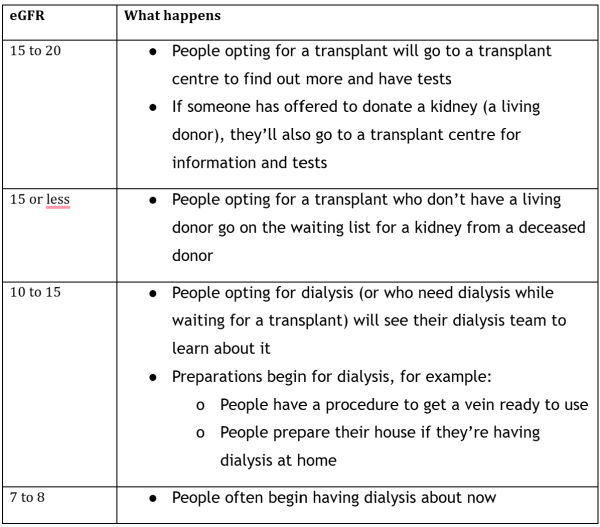
Here’s a rough timeline of what happens when. This was kindly provided by kidney doctor Grahame Wood.
How will kidney failure affect my life?
Living with kidney failure can be a lot to adjust to.
You’ll probably need to make changes to your diet, how much fluid you drink, and your lifestyle.
If you’re having dialysis, this can take up a lot of time and leave you tired. You’ll still be able to work, study, drive, exercise, and have holidays. You may need to change your schedule and take on less.
A kidney transplant will give you more freedom.
A counsellor or psychologist can help you to:
- Think through your options
- Work through your feelings
- Adapt to your health and treatment
Ask your kidney doctor, dialysis team, or transplant team if you’d like to talk to a counsellor or psychologist.
You may also find it helpful to talk to other people with kidney failure. You can connect with others through our Facebook groups and support groups.
You can also contact our helpline on 0300 111 123, on Facebook Messenger, or by emailing [email protected].
Can kidney failure be prevented?
Not everyone with ADPKD gets kidney failure. Once ADPKD damages your kidneys, this can’t be reversed.
You may be able to slow down damage to your kidneys with these steps:
- Follow your doctor’s advice to control your blood pressure if it’s high.
- Follow our tips on diet and lifestyle.
- Avoid medicines that may harm your kidneys.
If your kidney function is not low but is getting worse quickly, you might be able to take tolvaptan (Jinarc®). In clinical trials, tolvaptan slowed the speed at which some people’s kidneys grew. It also slowed their kidney damage.
Find out more about tolvaptan on our web page on medications to treat ADPKD.
More from the PKD Charity
Information and support from others
- Kidney Research UK has a booklet to help you decide which type of dialysis might be right for you and information on conservative care.
- The NHS has information on dialysis.
- NHS Blood and Transplant has information on kidney transplants.
- Kidney Care UK offers practical, emotional and financial support to people with a kidney condition and their families. Their support line is 0808 801 0000 or email [email protected].
The photos on this webpage are freely available on Pexels.com. The medical history of the persons shown is unknown.
Further information
All of our publications are based on references but these are removed for ease of reading on our webpages. A version of this webpage with references included is available upon request by emailing [email protected].
Authors and contributors
Written by Hannah Bridges, PhD, Independent Medical Writer at HB Health Comms Limited. Expert review by Dr Grahame Wood, Consultant Renal Physician, Salford Royal Hospital, Salford.
Ref No: ADPKD.KF.V1.0
© PKD Charity 2025
First published: September 2025
Due to be medically reviewed: September 2028
Disclaimer: This information is primarily for people in the UK. We have made every effort to ensure that the information we provide is correct and up to date. However, it is not a substitute for professional medical advice or a medical examination. We do not promote or recommend any treatment. We do not accept liability for any errors or omissions. Medical information, the law and government regulations change rapidly, so always consult your GP, pharmacist or other medical professional if you have any concerns or before starting any new treatment.
If you don't have access to a printer and would like a printed version of this information sheet, or any other PKD Charity information, call the PKD Charity Helpline on 0300 111 1234 (weekdays, 9am–5pm) or email [email protected]
The PKD Charity Helpline offers confidential support and information to anyone affected by PKD, including family, friends, carers, newly diagnosed or those who have lived with the condition for many years.