
Helpline

0300 111 1234

Haemodialysis

This information is for people with autosomal dominant polycystic kidney disease (ADPKD) who have or are nearing kidney failure. It’s also for their families and friends. It explains how you prepare for haemodialysis and what happens in haemodialysis sessions. It also looks at side effects and risks, monitoring and travel. 

See also our webpages introducing dialysis and about peritoneal dialysis.

Options for the treatment of kidney failure

If you have kidney failure, your treatment options may include:

  • a kidney transplant
  • dialysis (haemodialysis or peritoneal dialysis)
  • supportive medicines and care only

This page is on haemodialysis. To understand your other options, see our pages on Kidney transplants in ADPKD and an introduction to dialysis.

Preparing to have haemodialysis

If you choose to have haemodialysis, you’ll need a small surgical procedure beforehand to make a blood vessel easier to use.

There are two main access points that can be used for haemodialysis:

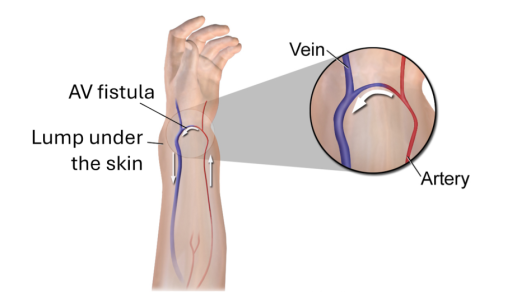
  • An AV fistula (also called an arteriovenous fistula) is an enlarged blood vessel in your arm.
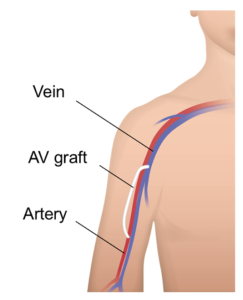
  • An AV graft (also called an arteriovenous graft) is a man-made tube that connects two blood vessels inside your arm.
Diagram showing an AV fistula. A vein and artery are shown running down the lower arm. The two vessels are joined so that blood can flow between them.
 Diagram showing an AV graft. A vein and artery are shown running down the upper arm. The two vessels are joined by a tube under the skin.

You and your dialysis team will decide together which type of access point is best for you and where it will go.

A surgeon will make your AV fistula or AV graft using a small surgical procedure. You’ll have a general or local anaesthetic for this. Your access point will stay in place long term unless you stop having haemodialysis.

Most people starting haemodialysis have an AV fistula made a few months beforehand. If you need to start dialysis more urgently than this, you might have an AV graft.

Less commonly, people have haemodialysis using a tube (a catheter) that feeds under their neck skin and into a neck vein. This is called a ‘tunnelled line’.

The risk of infection is higher with a tunnelled line. It’s only used for emergency dialysis or for people who can’t have an AV graft or AV fistula.

Haemodialysis sessions

Each haemodialysis session takes about 4 hours and most people need about 3 sessions per week. The length and frequency of your sessions will be tailored to you.

Most people have haemodialysis in a hospital or dialysis unit but some have the equipment at home.

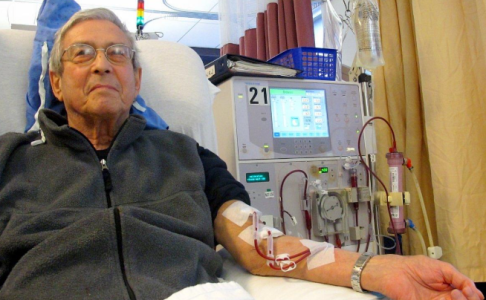
A man relaxed in a clinic chair beside a haemodialysis machine. The man has two tubes connected to his arm, carrying blood to and from the machine. The tubes are taped to his arm.

If you’re doing haemodialysis at home, you might be able to do shorter sessions more frequently. For example, these could be sessions of 3 hours on 5 days of the week or overnight sessions while you sleep.

At the hospital or dialysis unit, a nurse or healthcare assistant will insert two needles into your AV fistula or AV graft and connect tubes to these. Your blood will then travel through the tubes to and from the haemodialysis machine.

Alternatively, if you have a tunnelled line the nurse or healthcare assistant will use this to connect you to the dialysis machine.

You can learn to do some of the process yourself if you would like.

If you’re having home haemodialysis, you (or a relative or caregiver) will learn how to connect the haemodialysis machine. You’ll be able to contact your dialysis team for advice if you need.

The dialysis machine filters your blood through a man-made membrane, removing waste and excess fluid. You may hear the terms ‘haemofiltration’ or ‘haemodiafiltration’. These are slightly different processes for cleaning the blood.

Most people on haemodialysis have a blood thinner (usually heparin) before each session to reduce the risk of getting a blood clot.

Side effects and risks

Haemodialysis sessions can make you tired. Other side effects can include low blood pressure (which can make you feel sick or dizzy), itchy skin and muscle cramps. The needles can be uncomfortable — local anaesthetic can help.

If you have haemodialysis, there’s a risk of:

  • getting an infection in your access point, which could spread to your bloodstream
  • your access point getting blocked

You’ll need to follow advice to look after your access point to reduce the chance of infection. If you get an infection, you’ll need antibiotics either at home or in hospital.

If your AV fistula or AV graft gets blocked or narrows, you may need a procedure to correct this.

Monitoring

You’ll have regular monitoring (usually monthly) to check your dialysis schedule is working well to clean your blood and control your fluid levels.

This is also a chance for you and your dialysis team to review any side effects and discuss how haemodialysis is impacting your life. They might be able to suggest changes, treatments or support to help.

Travel

You can go on holiday and stay away from home if you’re on haemodialysis. You’ll need to plan ahead so a coordinator can book dialysis sessions at your destination for you. Alternatively, you can take a portable dialysis machine with you.

For more information, see Kidney Care UK’s guide Dialysis Away From Base. You can get help organizing dialysis away from home through their free service called Dialysis Freedom.

Information and support from others

University Hospitals Coventry and Warwickshire NHS Trust has a guide on making an access point in a blood vessel for haemodialysis. Services from other hospitals may differ.

Further information

All of our publications are based on references but these are removed for ease of reading on our webpages. A version of this webpage with references included is available upon request by emailing [email protected].

Authors and contributors

Written by Hannah Bridges, PhD, Independent Medical Writer at HB Health Comms Limited. Expert review by Matthew Gittus, PhD Fellow, Sheffield Kidney Institute, University of Sheffield.

With thanks to all those affected by ADPKD who contributed to this publication.

Ref No: ADPKD.HD.V1.0
© PKD Charity 2025
First published: June 2025
Due to be medically reviewed: June 2028

Disclaimer: This information is primarily for people in the UK. We have made every effort to ensure that the information we provide is correct and up to date. However, it is not a substitute for professional medical advice or a medical examination. We do not promote or recommend any treatment. We do not accept liability for any errors or omissions. Medical information, the law and government regulations change rapidly, so always consult your GP, pharmacist or other medical professional if you have any concerns or before starting any new treatment.

If you don't have access to a printer and would like a printed version of this information sheet, or any other PKD Charity information, call the PKD Charity Helpline on 0300 111 1234 (weekdays, 9am–5pm) or email [email protected].

The PKD Charity Helpline offers confidential support and information to anyone affected by PKD, including family, friends, carers, newly diagnosed or those who have lived with the condition for many years.

Feedback

We welcome feedback on the information provided on this webpage. If you have any feedback regarding the information provided on this webpage, please complete the Feedback Form