
Zahra's Story - A Trustee’s Voice for Change
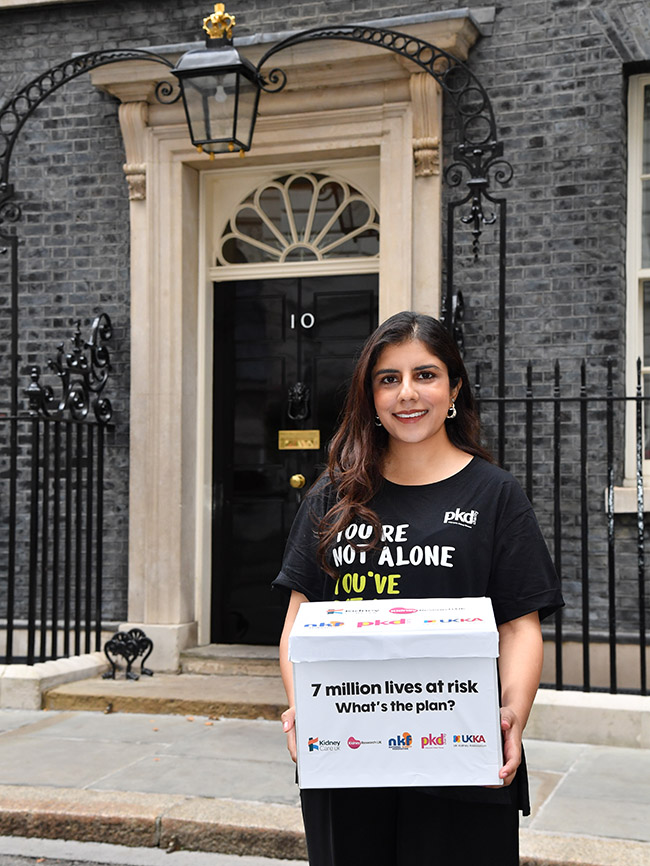
On 22 October 2025, patients and charities came together to urge the government to take decisive action on the escalating threat of kidney disease. Together, we delivered an open letter to 10 Downing Street, signed by over than 13,000 patients, clinicians, and supporters. The letter calls for a national strategy on kidney disease to improve early detection, prevention, and fair access to treatment across the UK.
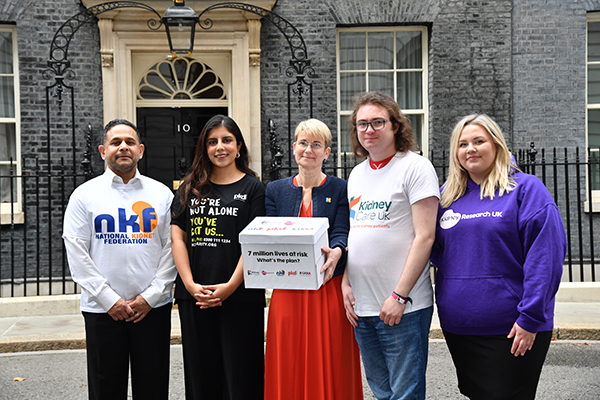
Among those attending was Zahra, a 27-year-old from London whose family has lived with Polycystic Kidney Disease (PKD) for three generations. Her grandmother (sadly now deceased) and her mother have both undergone transplants, and her two brothers also live with the condition.
Zahra, who works as a Project Manager for a global consultancy, is a Trustee of the PKD Charity, hosts our London support group, and is currently training for a half-marathon to raise funds and awareness.
Following the letter hand-in, the All-Party Parliamentary Kidney Group (APPG) met at Westminster, chaired by Jo White MP, where patients shared their stories and hopes for the future. Although it was Zahra’s first time attending an APPG meeting, she delivered a powerful and moving speech — reflecting on her upbringing by a single mother, the inequalities in the healthcare system, and her hopes for a fairer future if the government takes meaningful action on kidney disease.
" Good afternoon everyone and many thanks for the kind invitation to speak at today’s APPG.
My name is Zahra and I have Polycystic Kidney Disease, PKD, a genetic condition in which fluid-filled cysts replace healthy organ tissue, leaving patients needing dialysis and/or a transplant, and other treatments for serious side effects.
I grew up in a single parent, low-income household for most of my early life. The parent who raised me, my mother, is who I, and my brothers, inherited the condition from. She, in turn, inherited it from our grandmother - the first known patient in our family. Whilst my siblings and I were diagnosed in early adulthood, we were raised in the shadow of kidney disease.
Some of our earliest memories are of our mother and grandmother being hospitalised frequently and attending regular appointments, particularly for dialysis. Another recurring memory is being told money was always tight, because my mother’s health was too unpredictable to allow her to work.
Nonetheless, I was fortunate enough that my talents in life aligned to what we reward in British society: academic success. So, despite the burdens of caring responsibilities, poverty, racial discrimination to name a few, I stand before you as a multilingual, Cambridge graduate, employed at one of the most prestigious corporates in the world, with a second Trusteeship also already under my belt.
And yet, I now still face an uncertain future due to my own PKD - my diagnosis is not an odd that I can beat, certainly not in absence of kidney health being prioritised by this government and our NHS.
About 10% of the UK’s adult population is already affected by one of many different forms of kidney disease, all silent and invisible.
However, unseen does not mean untreatable. Currently, kidney conditions typically go undetected until an advanced stage of illness, requiring complex, costly, and life-altering interventions, namely dialysis and transplants.
Despite this, kidney disease remains underrepresented in national health strategies.
The NHS is spending billions treating cases that could be prevented or delayed through early detection and better management of risk factors such as diabetes, hypertension, and family history. Furthermore, the burden of kidney disease is not evenly shared. It disproportionately impacts ethnic minorities, older adults, and deprived communities, deepening existing health inequalities. Prioritising kidney disease, therefore, directly aligns with the government’s and NHS’s ambition to reduce such geographical and health inequity.
I want to stress how much potential there already is here. The UK already has brilliant kidney researchers, incredible charities, and a strong NHS network. With the right leadership and investment, we can change outcomes for kidney patients through earlier detection, better, longer-lasting treatments, and more support, whether financial, medical, or pastoral.
So, my ask is simple: keep kidney patients in mind when you decide health priorities, prevention strategies, and funding allocation. Every statistic is someone like me, trying to live a fulfilling and productive life, despite many odds.
And let me tell you, kidney disease is not another odd anyone should be trying to beat."
Zahra, Trustee of the PKD Charity and PKD Patient
What a Trustee of the PKD Charity Does
Even though being a trustee is a voluntary role, it carries serious responsibilities. Trustees help make sure the charity is well run, financially sound, and achieving its goals. This involves:
- Setting the charity’s direction: Helping decide the charity’s aims, priorities, and long-term plans.
- Overseeing finances: Approving budgets, checking spending, and making sure money is used properly and for the right purposes.
- Managing risks: Identifying and managing any risks to the charity’s work, reputation, or finances.
- Supporting and providing oversight to the chief executive or staff: Offering guidance and strategic direction without getting involved in day-to-day operations.
- Ensuring legal compliance: Making sure the charity follows the law, including charity, employment, and health regulations.
- Protecting the charity’s reputation: Acting as an ambassador, promoting our work, and maintaining public trust.
- Reviewing performance: Checking that the charity’s work is effective and that it’s meeting its goals.
- Upholding good governance: Attending trustee meetings, preparing properly, and taking collective responsibility for decisions.

If you would like to speak to us about what support we can offer you or a loved one, please visit PKD Support or contact us today and speak to a member of our team.
ADPKD, Fundraising, ARPKD, Organ Donation, PKD, PKDTreatment