Helpline

0300 111 1234

Terms of Use

We want you to enjoy your visit to the Polycystic Kidney Disease Charity (“PKDC”) website and we try to ensure that information on our site is accurate, complete and up-to-date.

All information contained on this site is intended for general educational, informational and helpful purposes only. It is not a substitute for professional medical advice or a medical examination. We do not promote or recommend any treatment.

We do not knowingly reproduce inaccurate or libellous material. Individuals and organisations referred to by us do not necessarily endorse this reference. Always seek the advice of your consultant, GP, or other qualified health professional before starting any new treatment. Medical information changes rapidly. We make efforts to update the content on the site but some information may be out of date.

Without prejudice to your statutory rights the site and all information, text, names, images, pictures, logos, links and icons and other materials (without limitation) are provided ‘AS IS’ and on an 'IS AVAILABLE' basis without representation warranty or endorsement, express or implied. In particular, the information provided on this site does not constitute business, medical or other professional advice, and is subject to change. Nor do we guarantee that use of this site will be uninterrupted or error-free, or that the site and its servers are free of computer viruses or bugs.

In no event will the PKDC be liable to any person for any injury, damage or loss that may arise from the use of any information contained in our site or products advertised on our site, including, without limitation, indirect or consequential damages, or any damages whatsoever arising from use or loss of use, data, or profits, whether in action of contract, negligence or other tort, arising out of or in connection with the use of the site.

HON Code of Conduct (HONcode) for medical and health websites

We try wherever possible to comply with HONcode Principles in particular with regard to:

  • Presentation of medical information
  • Purpose of the website
  • Privacy and confidentiality
  • Referenced and dated information
  • Disclosure of the governance of the PKDC and sources of funding

Copyright

All rights, including copyright and database right, in the PKDC website and its contents, are owned by or licensed to PKDC, or otherwise used by PKDC as permitted by applicable law or the copyright holder. You may not copy, reproduce, republish, download, post, broadcast or transmit any text, images, graphic, logo, button, icon, image and their selection and arrangement thereof, and any underlying source code and software, for any commercial or public purpose without prior written permission from PKDC or the copyright holder or in accordance with current Copyright, Designs and Patents Acts. You may not adapt, alter or create any of the material or information in this site or use it for any other purpose other than for your personal non-commercial use. You agree to use this site only for lawful purposes.

The PKDC reserves the right to use for its own purposes any material submitted to the site, including text and images, either on the site or in any other form, including for publicity purposes. The PKDC reserves the right to monitor submissions to the site and to edit or reject any submissions.

Trademarks

All names, images, logos identifying the PKDC are proprietary marks. All third party brand, product, service and company names contained on this site are the trademarks, service marks and trade names of their respective holders. The PKDC does not give permission for their use by any person other than the holders. Any such use may constitute an infringement of the holders’ rights.

External links

The PKDC has endeavoured to assess the quality of external sites but does not represent, warrant, endorse or hold responsibility over any external sites that may be linked to and from this site. Any external site that you visit by clicking through a link on this site is outside the control of the PKDC and you visit entirely at your own risk.

Jurisdiction

These Terms of Use shall be governed by and construed in accordance with the laws of England and Wales. Disputes arising here from shall be exclusively subject to the jurisdiction of the courts of England and Wales.

If any of these Terms should be determined to be illegal, invalid or otherwise unenforceable by reason of the laws of any state or country in which these Terms are intended to be effective, it shall be severed and deleted from this clause. All other Terms of Use and Terms and Conditions shall remain in full force and continue to be binding and enforceable.

The PKDC reserves the right to change these any of its terms and conditions at any time by posting changes online.

How to contact us

We welcome your feedback. Please leave your comments on the page provided or send a message using the Contact Us form on the site.

Or write to: The Polycystic Kidney Disease Charity, 86-90 Paul Street, London, EC2A 4NE
Phone: +44 (0) 20 7387 0543

Privacy notice

Privacy notice

The Polycystic Kidney Disease Charity understands that your privacy is important to you and that you care about how your personal data is used. We respect and value the privacy of all of our donors, beneficiaries, supporters, volunteers, staff and other stakeholders. We will only collect and use personal data in ways that are described here, and in a way that is consistent with our obligations and your rights under the law.

  • About Us

    The Polycystic Kidney Disease Charity (“the Charity”) is a registered charity in England and Wales (1160970) and Scotland (SC047730); and a company limited by guarantee registered in England and Wales under number 9486245. Our full contact details are below.

  • What does this Privacy Notice cover?

    This Notice explains how we use your personal data: how it is collected, how it is held, and how it is processed. It also explains your rights under the law relating to your personal data.

  • What is Personal Data?

    Personal data is defined by the UK General Data Protection Regulation (UK GDPR), tailored by the Data Protection Act 2018 (the “GDPR”) as any information relating to an identified or identifiable natural person. In simple terms, this means any information that enables you to be identified.

    Personal data covers obvious information such as your name and contact details, but it also covers less obvious information such as identification numbers, electronic location data, and information specific to your physical, physiological, genetic, mental, economic, cultural, or social identity.

  • What are your Rights?

    Under the GDPR, you have the following rights, which we will always work to uphold:

    • The right to be informed about our collection and use of your personal data. This Privacy Notice should tell you everything you need to know, but you can always contact us to find out more or to ask any questions.
    • The right to access the personal data we hold about you.
    • The right to have your personal data rectified if any of your personal data held by us is inaccurate or incomplete.
    • The right to be forgotten, i.e. the right to ask us to delete or otherwise dispose of any of your personal data that we have.
    • The right to restrict (i.e. prevent) the processing of your personal data.
    • The right to object to us using your personal data for a particular purpose or purposes.
    • The right to data portability. This means that you can ask us for a copy of your personal data held by us to re-use with another service or business in many cases.
    • Rights relating to automated decision-making and profiling. Note that however we do not use your personal data in this way.

    For more information about our use of your personal data or exercising your rights as outlined above, please contact us using the details below.

    You can obtain further information about your rights from the Information Commissioner’s Office or your local Citizens Advice Bureau.

    If you have any cause for complaint about our use of your personal data, you have the right to lodge a complaint with the Information Commissioner’s Office. The Charity is registered with the Information Commissioner, Number Z9468678. The Charity is also registered with the Fundraising Regulator.

  • What Personal Data do we collect?

    We may collect some or all of the following personal data (this will vary according to your relationship with us):

    • Name
    • Date of birth
    • Gender
    • Address
    • Email address
    • Telephone number
    • Business name
    • Job title
    • Profession
    • Payment information
    • Employment details
    • Information about your preferences and interests, such as fundraising or dietary needs for an event
    • Online identifier (IP address)

    The Charity does not collect special category or sensitive data as a matter of course. However, individuals may on occasion supply health-related information in relation to delivery of services by the Charity. For example, an individual needing befriending may share such information to enable the Charity to ‘match’ them to a volunteer; or an individual may share medical information that will help the Charity to liaise directly with a healthcare professional or similar on their behalf. The information is retained only as long as is necessary and is processed solely for this purpose.

  • How do we collect your Data?

    There are several ways we may collect information about you. These include:

    • When you provide it to us by getting in contact (phone/email/web form/via social media)
    • When you subscribe to receive our newsletter (electronic or postal) or place an order with us for products or services
    • When you register for and/or attend a Charity event

    We do not record phone calls that you make to us. However, if you leave a voicemail, the message is stored in an audio file. After we have answered your query, we will process any personal data in accordance with our privacy and retention policies, outlined below.

    If you send us an email, we will process any personal data in accordance with our policies, and to respond to your message.

    We sometimes use a form on our website to collect information. We delete the information after we have responded to any message and/or processed your personal data in accordance with our policies.

    If you send us a message via social media, your message will be stored by the social media platform in accordance with its own privacy policy.  If the message contains your personal data, we will process this in accordance with our own policies.

    We use a third party company, CharityDigital, to collect your personal data for the purpose of sending you information and marketing communications by email. See below for more information about how your data is stored securely.

    We use a third party company, Eventbrite, to collect your personal data when you register for an event with us. See below for more information about how your data is stored securely.

    We may also collect information about you if you consent to the use of cookies when using our website. For example, we use Google Analytics to collect information from our website to help us analyse how many visitors use the site and what pages they read. This information does not directly identify you, the visitor, and we don’t allow Google to try to find out your identity.

  • How do we use your Personal Data?

    Under the GDPR, we must always have a lawful basis for using personal data. This may be because the data is necessary for our performance of a contract with you, because you have consented to our use of your personal data, or because it is in our legitimate interests to use it. We will use your personal data for one of the following purposes:

    • Internal record keeping.
    • Maintaining a record of Gift Aid Declarations for HMRC.
    • Providing our services to you.
    • Providing goods that you have purchased.
    • Personalising and improving services for you.
    • Communicating with you. This may include responding to emails or calls from you.
    • Supplying you with information by email AND/OR post that you have opted-in to (you may unsubscribe or opt-out at any time by contacting us using the details below or clicking Unsubscribe in relevant emails).
    • Carrying out research and getting feedback.
    • Statistics reporting.
    • Evaluating website performance.

    With your permission and/or where permitted by law, we may also use your personal data for marketing purposes, which may include contacting you by email AND/OR telephone AND/OR text message AND/OR post with information, news, and fundraising appeals.

    We will not send you unlawful marketing or spam. We will always work to fully protect your rights and comply with our obligations under the GDPR and the Privacy and Electronic Communications (EC Directive) Regulations 2003, and you will always have the opportunity to opt-out.

  • How long will we keep your Personal Data?

    We will not keep your personal data for any longer than is necessary in light of the reason(s) for which we first collected it. The table below shows how long we will keep your personal data. The retention period is determined by the type of data.

    The Charity may hold information on individuals under 16 but only with the express permission of parents/guardians. We will review the retention period schedule every 3 years.

    Description Type of Data Purpose of Data Retention Period
    Gift Aid Declarations and Associated HMRC Schedules Name, address, postcode Claim Gift Aid on donations No longer than the end of the tax year following 7 years from the last donation.
    Supporters Name, address, contact details, interests; online identifier Provide updates on activities and promote fundraising Indefinitely, in accordance with GDPR.
    Donors (fundraisers) Name, address, contact details, fundraising amount; online identifier Record donations for accounting purposes; maintain ongoing contact No longer than the end of the tax year following 7 years from the last donation. In the case of legacies, no longer than the end of the tax year 7 years after the legacy is received.
    Beneficiaries, including delegates at education days Name, address, contact details, sensitive data (medical, genetic); online identifier EnableProvide support and updates on activities Indefinitely, in accordance with GDPR.
    Trustees Name, address, contact details; DOB; nationality; bank details Legal As required by the Charity Commission and Companies Act
    Volunteers Name, address, contact details; bank details Management and governance; safeguarding Indefinitely, in accordance with GDPR
    Healthcare Professionals Name, address, contact details, speciality Provide updates and engage Indefinitely in accordance with GDPR
    Survey respondents Online identifier; and sometimes personal data Gather feedback 3 years
    Photo/video permissions Name, address, contact details Case studies, PR. NB: some permissions may refer to children under 16 years but these are only held with the express permission of parents/guardians. Indefinitely, in accordance with GDPR
    Contractors & Employees Name, address, contact details, bank details Contractual As determined by accounting and HR legislation
    Competitions, raffles etc Name, address, contact details Informing, clarifying 5 years
    General enquiries Name, address, contact details, online identifier Provide information and signpost to other resources 2 years
  • How and where do we store or transfer your Personal Data?

    We will aim to store your personal data in the UK OR within the European Economic Area (the “EEA”). The EEA consists of all EU member states, plus Norway, Iceland, and Liechtenstein. This means that your personal data will be fully protected under the GDPR or to equivalent standards by law.

    However, due to the global structure of the internet and use of cloud servers, we may store or transfer some or all of your personal data in countries that are not part of the European Economic Area (the “EEA” consists of all EU member states, plus Norway, Iceland, and Liechtenstein). These are known as “third countries” and may not have data protection laws that are as strong as those in the UK and/or the EEA. This means that we will take additional steps in order to ensure that your personal data is treated just as safely and securely as it would be within the UK and under the GDPR including:

    • Obtaining copies of Data Protection and Data Processing Agreements
    • Ensuring non-EEA organisations have Privacy Shield Certification

    We use a third party company, Softforge, to manage and host our www.pkdcharity.org.uk website. The company has security in place to spot hacking attempts and any performance issues with the site. The web server is in the UK and they hold back-ups in Ireland.

  • How secure is your Data?

    The security of your personal data is essential to us. The Charity has taken appropriate technical and organisational measures to mitigate such risks as loss or unauthorised access, destruction, use, modification or disclosure of data.

    Because the internet is not completely secure, any email you send to us is sent at your own risk. All incoming emails are automatically monitored for spam and blocked if considered unsafe. It is your responsibility to ensure that any email you send us is lawful and does not contain a virus.

  • Do we share your Personal Data?

    We will not share any of your personal data with any third parties for any purposes, subject to one important exception.

    In some limited circumstances, we may be legally required to share certain personal data, which might include yours, if we are involved in legal proceedings or complying with legal obligations, a court order, or the instructions of a government authority.

    We do sometimes contract with the following third parties to supply services to you on our behalf. These may include payment processing, delivery, and marketing. In some cases, those third parties may require access to some or all of your personal data that we hold.

    • PayPal
    • Charity Checkout
    • JustGiving
    • VirginMoney Giving
    • BTMyDonate
    • CAF Donate
    • Accountants

    If any of your personal data is required by a third party, as described above, we will take steps to ensure that your personal data is handled safely, securely, and in accordance with your rights, our obligations, and the third party’s obligations under the law.

    Some of those third parties are located outside of the European Economic Area. If any personal data is transferred to a third party outside of the EEA, we will take suitable steps in order to ensure that your personal data is treated just as safely and securely as it would be within the UK and under the GDPR, as explained above.

  • How can you access your Personal Data?

    If you want to know what personal data we have about you, you can ask for details of that personal data and for a copy of it. This is known as a “subject access request”.

    All subject access requests should be made in writing and sent to the email or postal addresses shown below. To make this as easy as possible for you, a Subject Access Request Form is available for you to use. You do not have to use this form, but it is the easiest way to tell us everything we need to know to respond to your request as quickly as possible.

    There is not normally any charge for a subject access request. If your request is ‘manifestly unfounded or excessive’ (for example, if you make repetitive requests) a fee may be charged to cover our administrative costs in responding.

    We will respond to your subject access request within not more than one month of receiving it. Normally, we aim to provide a complete response, including a copy of your personal data within that time. In some cases, however, particularly if your request is more complex, more time may be required up to a maximum of three months from the date we receive your request. We will keep you fully informed of our progress.

  • Changes to this Privacy Notice

    We may change this Privacy Notice from time to time. This may be necessary, for example, if the law changes.

    This Privacy Notice was adopted on 23 May 2018

  • How to Contact Us

    Registered office: 86-90 Paul Street, London, EC2A 4NE
    Office phone: 020 7387 0543
    Office email: [email protected]

    Data Protection Trustee: Mr Nicholas Tracey, 

Read more …Privacy notice

Newsletter

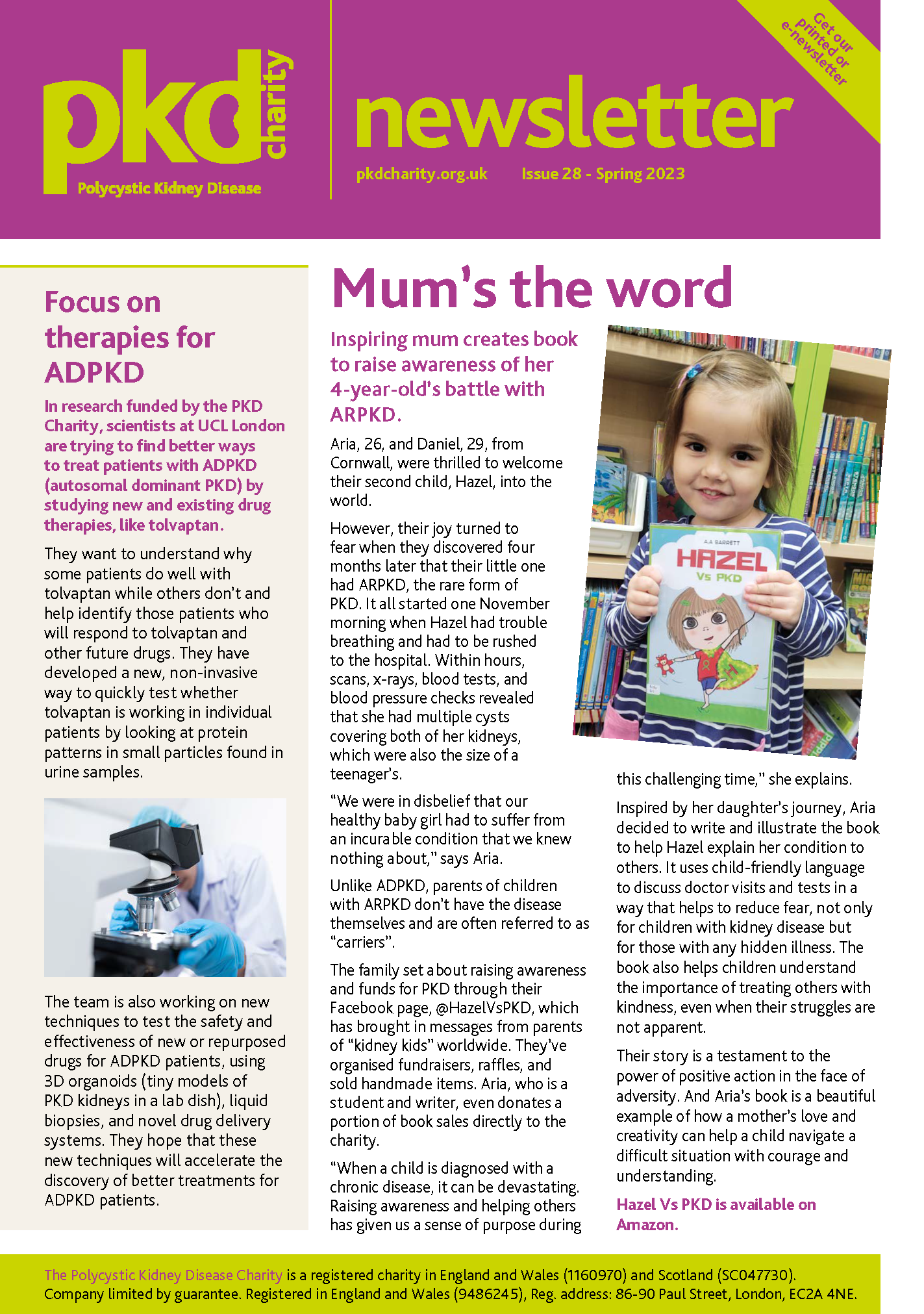
PKD Charity Newsletter

Newsletters

Subscribe to our newsletter to stay up to date or browse our library of previous issues.

Previous newsletters:

Read more …Newsletter

Financial advice

Financial advice

If your polycystic kidney disease (PKD) causes symptoms, it might affect your ability to work. Or, you might need to reduce your working hours to look after a child or other family member with PKD. This can have a knock-on effect on your finances. This page explains where to find financial advice, including about the benefits you might be entitled to claim.

What benefits might I be entitled to claim?

The benefits to which your entitled in the UK depend very much on your circumstances, including whether you:

  • are employed (and if so, how much you earn)
  • are looking for work
  • have a disability or health condition that affects how much you can work
  • are temporarily unable to work due to illness
  • act as a carer for someone.

There are many other benefits you might be eligible to claim that don’t relate directly to your health, such as child benefit and housing benefit.

The government websites for England, Wales, Scotland and Northern Ireland have lots of information on benefits. But it can be hard to find your way around the advice and work out which benefits might apply to you.

You may find it easier to ask an adviser at Citizens Advice

Citizens Advice is a network of independent charities providing confidential advice. They aim to help people who face problems that seem complicated or overwhelming. They help millions of people each year.

You can chat to them on their website, by dropping into a local branch, or by calling the helpline for your area of the UK:

  • England: 0800 144 8848
  • Wales: 0800 702 2020
  • Scotland: 0800 028 1456
  • Northern Ireland: 0800 915 4604

What help is available with energy bills?

Citizens Advice can also explain what to do if you’re struggling to pay your energy bills, including:

  • How to agree a payment plan with your supplier
  • Getting grants or benefits to help pay energy bills.

See above for their contact details.

Other organisations offering advice

The charities and organisations below may be able to help you.

  • Kidney Care UK

    KCUK offers a UK-wide advocacy service to kidney patients. Their Advocacy Officers' role is to speak up for kidney patients and ensure their rights are respected and their views heard.

    Ring the KCUK Helpline 01420 541424 or visit the Kidney Care UK website.

  • Turn2us

    Turn2us is a UK charity which helps people check what benefits are available to them. They also provide information about grants and other financial help.

    Find out more about Turn2us

  • NKF

    The National Kidney Federation (NKF) helps people with a range of information including benefits. They also campaign on behalf of all kidney patients to help improve equality of access to care.

    View the NKF Benefits Guide or ring their helpline on 0800 169 0936.

Read more …Financial advice

Insurance

Insurance

This fact sheet is for people with polycystic kidney disease (PKD) in the UK looking for health, travel, life or critical illness insurance. It explains why it can be harder to find insurance if you have a long-term health condition and why your premiums may be higher. This is a basic guide only: for tailored advice, please speak to an experienced insurance broker.

Contents

What types of insurance relate to your health?

Common insurance products that can be affected by any health conditions you already have are:

  • Health insurance (private medical insurance): pays for private tests and treatments for illnesses. Often only short-term (acute) illnesses are covered not long-term (chronic) ones.
  • Travel insurance: helps with costs of a variety of problems that can happen during your trip, including emergency medical care, cancellations or delays, and lost or stolen belongings.
  • Life insurance: gives an agreed sum of money to your family or a loved one if you die, either as a single payment or regular payments.
  • Critical illness insurance: gives you an agreed sum of money if you’re diagnosed with a condition named in the policy (for example, cancer, a heart attack, or Alzheimer’s disease).

Why does having PKD affect your insurance?

Autosomal dominant polycystic kidney disease (ADPKD) and autosomal recessive polycystic kidney disease (ARPKD) are lifelong conditions that affect your kidneys.

They make it more likely that you’ll become unwell and need medical care. This could make it harder to find affordable insurance in a number of ways:

Health, travel and critical illness insurance

  • Standard policies usually don’t cover conditions you already had before you signed up (a pre-existing condition). This means if you had PKD before you took out the insurance cover and you get ill because of your PKD, it would not be covered.
  • Many standard policies don’t cover long-term conditions, so if you’re diagnosed with PKD after you take out the insurance cover, it would not be covered.
  • Some specialist insurers will agree to tailor a policy for you to take into account your PKD. But the amount you pay for the insurance (the premium) is likely to be higher than standard.

Life insurance

  • Because you have a long-term condition, your premiums for life insurance are likely to be higher than they otherwise would be.
  • Not all insurers will agree to cover you, so you may need to shop around.

This may feel very unfair but remember that insurance companies are businesses. They need to be sure that their business can make a profit overall to exist and honour the claims they have agreed to make.

How to find the best insurance option for you

Finding the best insurance if you have a long-term condition can be tricky. Here are some tips:

  • Use an insurance broker: An insurance broker or advisor can help you by explaining the pros and cons of different options, including what each policy does and doesn’t cover [5]. They should also know which companies offer tailored insurance products. You can find a broker via the British Insurance Brokers' Association (BIBA) or the Association of Medical Insurers and Intermediaries (AMII).
  • Do your research: Give yourself plenty of time to read through each policy carefully. What is covered and what is excluded? How much is the premium? What is the maximum claim? Do you need to pay money towards a claim (the excess)?
  • See what others say: To choose between providers, it can help to look for independent customer reviews online. For example, how easy have others found it to make a claim if needed? Remember that products change over time and your policy might differ to others’ though, so your own experience could differ to theirs.
  • Consider getting separate insurance: If you’re looking for insurance for you and your family, look into whether it is better to get your insurance separately to theirs. This means the rest of your family might be able to benefit from a cheaper, standard policy.

What if you don’t tell the insurance company that you have PKD?

When asked, you should always let your insurer know about any health conditions you’ve been diagnosed with. You should also keep them up to date about any new conditions you develop, in line with your policy.

If you don’t share this information, it could invalidate your whole insurance policy. This means any claim you make could be refused, whether or not it relates to your PKD.

What if you have a PKD gene but have no signs of ADPKD?

If a relative of yours has been diagnosed with ADPKD, you might decide to get a genetic test to see if you have the gene too. If you have no symptoms, this is called a predictive test, as it is being used to predict whether you’ll develop ADPKD in the future.

Insurers are not allowed to ask you about the results of predictive genetic tests or use them to set premiums. However, if a genetic test was used to confirm your diagnosis of ADPKD, you do need to let them know if asked.

Genetic tests for ARPKD would usually be diagnostic, as it’s unlikely you would not have any symptoms.

If you’re not sure whether your genetic test was diagnostic or predictive, ask your genetics counsellor, kidney specialist, or GP to confirm.

To learn more about genetic testing and insurance, see the Association of British Insurers (ABI) guide

Information and support from others

UK insurance companies

By law, we cannot recommend any insurer or financial services provider. However, we are confident that the companies listed below can help you. They have access to a large panel of leading insurers, so that you can compare prices and choose the policy that best suits your needs.

For every policy sold, some firms will give a donation directly to the PKD Charity at no additional cost to you. These firms already work with a number of charities like us on the same basis. But please note that we are not endorsing them as exclusive providers of cover.

Authors and contributors

Written by Hannah Bridges, PhD, HB Health Comms Ltd, UK.

With thanks to all those affected by ADPKD who contributed to this publication.

Ref No: PKD.INS.V2.0
Last updated: Jul 2023
Next scheduled review: Jul 2026

Disclaimer: This information is primarily for people in the UK. We have made every effort to ensure that the information we provide is correct and up to date. However, it is not a substitute for professional medical advice or a medical examination. We do not promote or recommend any treatment. We do not accept liability for any errors or omissions. Medical information, the law and government regulations change rapidly, so always consult your GP, pharmacist or other medical professional if you have any concerns or before starting any new treatment.

We welcome feedback on all our health information. If you would like to give feedback about this information, please email

If you don't have access to a printer and would like a printed version of this information sheet, or any other PKD Charity information, call the PKD Charity Helpline on 0300 111 1234 (weekdays, 9:30am-5pm) or email [email protected].

The PKD Charity Helpline offers confidential support and information to anyone affected by PKD, including family, friends, carers, newly diagnosed or those who have lived with the condition for many years.

Read more …Insurance

PKD research study groups

PKD research study groups

PKD research study groups

There are two UK clinical/research study groups, one for ADPKD (autosomal dominant polycystic kidney disease) and one for ARPKD (autosomal recessive polycystic kidney disease). If you are a doctor or other healthcare professional, and are interested to join either or both groups, please contact us.

  • ADPKD Clinical Study Group

    The ADPKD Clinical Study Group (CSG) is part of the UKKRC (UK Kidney Research Consortium). Kidney Research coordinate the work of the UKKRC.

    Find out more about the CSG here

  • ARPKD Rare Disease Group

    The ARPKD Rare Disease Group (RDG) is part of the UK Kidney Research Association (formerly the Renal Association).

    Find out more about the RDG here

Thank you for supporting PKD research

Please Donate

Read more …PKD research study groups

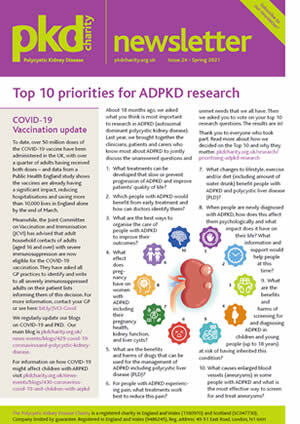
ADPKD research priorities

ADPKD research priorities

ADPKD research priorities

The views of people affected by ADPKD are vital when deciding what to research. We asked the James Lind Alliance (who specialise in prioritising research) to help us prioritise the views of people affected by ADPKD (either directly or due to ADPKD in their family) and healthcare professionals.

To find the top 10 priorities, we funded a research Priority Setting Partnership (PSP), overseen by a steering group which included people living with and affected by ADPKD, healthcare professionals and the James Lind Alliance

We summarised 117 questions about ADPKD care and management that hadn't been answered by research into a shortlist of 35. We asked patients, family members, carers and healthcare professionals to rank which of the 35 questions were the most important to them. Over 700 people replied to our survey. The Top 10 research questions below are the result.

Read the ADPKD research priorities report (PDF, 737 KB) for more detail on each of these priorities and how we arrived at the Top 10.

Read the BMJ Open Paper.

Our next step is to encourage researchers to use the Top 10 list (and the other questions that didn’t make the top 10) to inform their research plans. 

The Top 10

  • 1. What treatments can be developed that slow or prevent progression of ADPKD and improve patients’ quality of life?

    ADPKD gets worse over time, causing damage to the kidneys. This is called progression.

    Most treatments that people with ADPKD receive can reduce symptoms but don’t prevent the disease progressing.

    For many people, damage to the kidneys eventually means they will need dialysis or a kidney transplant.

    ADPKD can also cause other health problems as it progresses. Tolvaptan (Jinarc®) is the only treatment available that can help to slow ADPKD progression in some patients.

    This research question aims to find new treatments that can slow or prevent ADPKD progression and so improve patients’ lives.

  • 2. Which people with ADPKD would benefit from early treatment and how can doctors identify them?

    For some people, early treatment may slow the progression of ADPKD and reduce the problems it causes.

    For other people, some treatments may not work as well or might cause too many side effects.

    This research will help doctors identify the people who will benefit from each treatment.

    This means patients can start to benefit from the right treatment sooner.

  • 3. What are the best ways to organise the care of people with ADPKD to improve their outcomes?

    ADPKD doesn’t only affect the kidneys — it can affect other parts of the body too, such as the liver.

    This means people with the disease usually need to see a range of doctors specialising in different parts of the body during their lives.

    Some people with ADPKD tell us that they experience inconsistencies or gaps in their care.

    This can leave people frustrated and unsure whether they are getting the best care.

    This research question aims to work out the best ways that different specialists providing care to people with ADPKD can work together consistently to support their patients’ health.

  • 4. What effect does pregnancy have on women with ADPKD including their pregnancy health, kidney function, and liver cysts?

    We do not know much about how pregnancy affects the bodies of women with ADPKD.

    For example, does carrying a baby cause extra damage to the kidneys of women with ADPKD?

    Can it make their liver cysts grow faster?

    Based on this research, doctors will be able to give women with ADPKD a clearer picture of any risks of pregnancy to them and their babies.

    This research may also help to work out which treatments could reduce the chance of these problems occurring.

  • 5. What are the benefits and harms of drugs that can be used for the management of ADPKD including polycystic liver disease (PLD)?

    There are a number of treatments to help manage ADPKD. For patients to be able to choose between the different treatments they are offered, they need to know the possible benefits and side
    effects of each.

    Yet there is not much research on risks and benefits, making it hard for healthcare professionals to give detailed advice on this.

    This research will give patients and healthcare professionals a clearer picture of the benefits and risks of each treatment so they can be confident in selecting the right one together.

  • 6. For people with ADPKD experiencing pain, what treatments work best to reduce this pain?

    Kidney pain caused by ADPKD can be disabling and have a big impact on people’s lives. ADPKD pain can be hard to treat.

    Sometimes the source of the pain (such as a cyst infection) is difficult to find or treat.

    If researchers can discover which treatments are most effective for ADPKD pain, they can make a massive difference to some people’s lives.

  • 7. What changes to lifestyle, exercise and/or diet (including amount of water drunk) benefit people with ADPKD and polycystic liver disease (PLD)?

    Many people with ADPKD want to know what steps they can take to stop their disease worsening. We know that a healthy lifestyle and certain changes to diet (for example, not eating too much salt) can help.

    We don’t have all the answers yet though, such as whether drinking a lot of water helps to keep the kidneys healthy.

    This research can provide those answers, and so help people with PKD to take more active steps to protect their health and be in control of their disease.

  • 8. When people are newly diagnosed with ADPKD, how does this affect them psychologically and what impact does it have on their life? What information and support would help people at this time?

    A diagnosis of ADPKD can turn your life upside down and trigger a wide range of emotions.

    Getting the right information and support can make an enormous difference. It can help you to cope, feel in control, and plan positively for the future.

    People with ADPKD tell us that we still have more to do in this area.

    This research will give people with ADPKD the chance to be heard. The results will mean better information and support for all patients, whether newly diagnosed or living with ADPKD for some time.

  • 9. What are the benefits and harms of screening for and diagnosing ADPKD in children and young people (up to 18 years) at risk of having inherited this condition?

    Tests are available to check for ADPKD in people who might have inherited the condition. This is called screening.

    Screening for ADPKD in children who might have inherited the condition has some clear benefits. For example, children found to have ADPKD can begin to receive any treatments that might help. However, screening can also cause harm, such as making children and their parents anxious about their health and future.

    This research will explore the benefits and harms of screening children. It will help us to understand which benefits and harms are most important to children, young people, and their families. The results will help similar people in the future choose whether or not they want to have screening tests.

  • 10. What causes enlarged blood vessels (aneurysms) in some people with ADPKD and what is the most effective way to screen for and treat aneurysms?

    ADPKD can increase the risk of getting a swollen blood vessel (an aneurysm), particularly in the brain.

    Brain aneurysms often don’t cause a problem, but in some people they burst and bleed, which can cause a stroke or death. This makes aneurysms a source of great fear for some people with ADPKD, especially if other family members have had one. Some procedures can treat aneurysms before they burst.

    This research will help us to understand more about aneurysms: why they occur in people with ADPKD, how they can be spotted early (through screening), and how they can be treated.

    This research could save lives, reduce disability and reduce the anxiety that aneurysms cause.

You can see the shortlist of 35 questions, with the underlying list of 117 research uncertainties, on the website of the James Lind Alliance.

Read the ADPKD PSP scope here.

Thank you!

We would like to thank everyone with ADPKD, family member, carer, and healthcare professional who took part in this PSP and the James Lind Alliance facilitators. Without their time and opinions, this PSP would not have been possible. To get involved or for more information about our research priorities, do get in touch here [email protected]

Current partners

Read more …ADPKD research priorities

Feedback

We welcome feedback on the information provided on this webpage. If you have any feedback regarding the information provided on this webpage, please complete the Feedback Form